3d drawing of an engine
The 3D game engines that are behind today's biggest games are staggering works of mathematics and programming, and many game developers find that agreement them in their entirety is a difficult task. If you are lacking in experience (or a college degree, like myself), this chore becomes fifty-fifty more arduous. In this series, I aim to walk you through the basics of graphics systems in 3D engines.
More than specifically, in this tutorial we will exist discussing points and vectors, and all of the fun that comes with them. If you have a basic grasp of algebra (variables and variable math) and Computer Science (the nuts of any object-oriented programming language), you lot should be able to make it through most of these tutorials, simply if you're having trouble with any of the concepts, please ask questions! Some of these topics tin can exist terribly difficult.
You can also get extra help over on Envato Studio, where yous tin notice plenty of fantastic 3D Design & Modeling services for affordable prices.


Basics of Coordinate Systems
Let's start from the basics. Three-dimensional graphics require the concept of a three-dimensional space. The about widely used of these spaces is called the Cartesian Infinite, which gives us the benefit of Cartesian coordinates (the bones \((10,y)\) notations and 2D grid-spaced graphs that are taught in most high schools).

iii-dimensional Cartesian space gives us an x, y, and z axis (describing position based on horizontal placement, vertical placement, and depth respectively). The coordinates for whatsoever point within this infinite are shown as a tuple (in this instance a iii-tuple, since there are iii axes). On a 2-dimensional aeroplane, a tuple could be depicted as \((x,y)\), and in 3-dimensional aeroplane, it is depicted as \((x,y,z)\). The utilize of this three-tuple is that it shows a point's location relative to the space's origin (which itself is typically shown as \((0,0,0)\)).
Tip: Tuple: an ordered list (or sequence) of elements in computer science or mathematics. So, \((Yard,y,50,e)\) would be a iv-tuple, showing a sequence of characters that make up my name.


Within this space, we are going to define a point every bit a representation of a 3-tuple. This can too exist shown every bit:
\[P = (x,y,z)\]
In addition to this definition of a point, we must ascertain its parts.
Each of the elements within this 3-tuple is a scalar (number) that defines a position forth a basis vector. Each basis vector must have a unit of measurement length (that is, a length of exactly ane), so 3-tuples such as \((1,1,one)\) and \((2,two,2)\) could not be basis vectors every bit they are likewise long.
We define iii basis vectors for our space:
\[\begin{aligned}
10 & = (ane,0,0)\\
Y & = (0,ane,0)\\
Z & = (0,0,1)
\end{aligned}\]

The Coordinate System
Now let's talk about the mathematical definition of our coordinate system, how it affects our graphics system, and the calculations nosotros tin can brand.
Representing Points
The origin point of our coordinate system can be depicted equally the point \(O\), which represents the three-tuple (0,0,0). This ways that the mathematical representation of our coordinate system can be depicted as:
\[\{O;X,Y,Z\}\]
Past this statement, you tin can say that \((10,y,z)\) represents a point's position in relation to the origin. This definition also means that any signal \(P\), \((a, b, c)\), tin can be represented as:
\[P = O + aX + bY + cZ\]
From here on, I will reference scalars in lower-case and vectors in upper-case - so \(a\), \(b\), and \(c\) are scalars, and \(Ten\), \(Y\), and \(Z\) are vectors. (They are actually the basis vectors nosotros defined earlier.)
This means that a indicate whose tuple is (2,3,iv) could be represented as:
\[\begin{aligned}
(2,3,4) & = (2,0,0) + (0,3,0) + (0,0,iv)\\
& = (0,0,0) + (two,0,0) + (0,three,0) + (0,0,4)\\
& = (0,0,0) + 2(1,0,0) + three(0,1,0) + 4(0,0,ane)\\
& = O + 2X + 3Y + 4Z\\
\terminate{aligned}\]
And so, we've taken this abstruse concept of "a signal in 3D space" and divers information technology as four separate objects added together. This kind of definition is very important whenever we desire to put whatever concept into code.
Mutually Perpendicular
The coordinate system that we will be using likewise has the valuable holding of beingness mutually perpendicular. This means that there is a 90 degree angle betwixt each of the axes where they meet on their respective planes.

Our coordinate organization will besides exist defined as "right-handed":

In mathematical terms, this means that:
\[Ten = Y \times Z\]
...where \(\times\) represents the cross product operator.
In instance y'all aren't certain what a cross product is, it tin can exist divers by the following equation (assuming you are given ii 3-tuples):
\[(a,b,c) \times (d,e,f) = (bf - ce, cd - af, ae - bd)\]
These statements might seem tedious, merely afterward on, they will permit united states of america to do a diverseness of dissimilar calculations and transformations much more hands. Luckily, you don't have to memorize all of these equations when building a game engine - y'all can simply build from these statements, so build fifty-fifty less complicated systems on superlative of that. Well, until you have to edit something fundamental within your engine and accept to refresh yourself on all of this once more!
Points and Vectors
With all of the basics of our coordinate system locked down, its time to talk about points and vectors and, more than importantly, how they interact with one some other. The first thing to note is that points and vectors are distinctly different things: a point is a concrete location within your space; a vector is the space between 2 points.
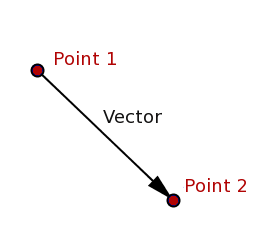
To make sure that the two don't go confused, I'll write points in capital letter italics, every bit \(P\), and vectors in capital letter boldface, equally \(\mathbf{5}\).
In that location are two main axioms that nosotros are going to deal with when using points and vectors, and they are:
- Axiom 1: The deviation of two points is a vector, so \(\mathbf{5} = P - Q\)
- Axiom 2: The sum of a point and a vector is a point, and then \(Q = P + \mathbf{V}\)
Tip: An axiom is a bespeak of reasoning, often seen every bit evident enough to be accustomed without statement.
Building the Engine
With these axioms stated, we now have enough information to create the building block classes that are at the heart of whatsoever 3D game engine: the Betoken grade and the Vector course. If we were going to build our ain engine using this data, in that location would be some other important steps to have when creating these classes (mostly having to practise with optimization or dealing with already existing APIs), merely we are going to leave these out for the sake of simplicity.
The class examples beneath are all going to exist in pseudocode and so that yous tin can follow forth with your programming linguistic communication of selection. Here are outlines of our two classes:
Indicate Course { Variables: num tuple[three]; //(x,y,z) Operators: Point AddVectorToPoint(Vector); Indicate SubtractVectorFromPoint(Vector); Vector SubtractPointFromPoint(Point); Function: //later this volition call a part from a graphics API, only for now //this should just be printing the points coordinates to the screen drawPoint; } Vector Class { Variables: num tuple[3]; //(10,y,z) Operators: Vector AddVectorToVector(Vector); Vector SubtractVectorFromVector(Vector); } As an exercise, try to fill in each of these form's functions with working code (based on what nosotros've gone over then far). Once you've gotten all of that finished, put it to the examination by making this example program:
master { var point1 = new Point(1,2,ane); var point2 = new Point(0,4,4); var vector1 = new Vector(ii,0,0); var vector2; point1.drawPoint(); //should brandish (1,ii,1) point2.drawPoint(); //should display (0,4,4) vector2 = point1.subtractPointFromPoint(point2); vector1 = vector1.addVectorToVector(vector2); point1.addVectorToPoint(vector1); point1.drawPoint(); //should display (4,0,-2) point2.subtractVectorFromPoint(vector2); point2.drawPoint(); //should display (-1,6,seven) } Conclusion
You fabricated it to the cease! It may seem like an awful lot of math to but brand two classes - and it definitely is. In near cases you volition never have to work on a game at this level, but having an intimate knowledge of the workings of your game engine is helpful however (if only for the self-satisfaction).
If y'all thought that this was fun, and then make sure to cheque out my next tutorial on graphics organisation nuts: transformations!
Of grade, once you've created the graphics engine, yous'll need to add some content, and so feel free to check out the wide selection of game assets and 3D models on Envato Market.
Source: https://gamedevelopment.tutsplus.com/tutorials/lets-build-a-3d-graphics-engine-points-vectors-and-basic-concepts--gamedev-8143

Post a Comment for "3d drawing of an engine"